Choosing a hair transplant in Korea means picking between clinics, techniques, and coordination services that all claim the same thing: natural results, no scarring, fast recovery. This guide breaks down what actually matters for international patients booking a hair transplant in Korea for foreigners in 2026, and what to skip.
- FUE and DHI dominate hair transplant korea foreigners bookings in 2026 — DHI wins for hairline density work.
- Grafts commonly run 2,000 to 3,500 per session; full chair time averages 6 to 8 hours.
- KHIDI-registered coordination lowers the risk of unlicensed clinics — verify registration before you book.
- Skip any clinic quoting a flat session price with no graft-count breakdown — that's a red flag, not a deal.
Why This Matters
Seoul has become a default stop for international patients researching hair restoration, not just rhinoplasty and jaw surgery. The city has a dense cluster of dermatology and hair-transplant clinics, several with English-language coordination built specifically for foreign patients flying in from the US, UK, Canada, and Australia.
The problem is that "hair transplant in Korea" now covers everything from board-certified surgeons doing manual FUE extraction to high-volume clinics that hand extraction off to technicians with minimal oversight. Seoul Cosmetic Surgery matches patients with KHIDI-registered partner clinics precisely because the gap between a good and a bad hair transplant provider in Korea is wide, and it's invisible from a clinic's website.
Who This Guide Is For
This is written for foreign patients with male or female pattern hair loss, a receding hairline, or post-surgical scarring who are comparing Korean clinics against options at home. If you're weighing FUE against DHI, trying to figure out what a realistic graft count looks like for your donor area, or wondering whether a $6,000 quote is reasonable for 2026, this is your starting point.
What to Look For in a Hair Transplant in Korea for Foreigners
Graft Technique on Offer
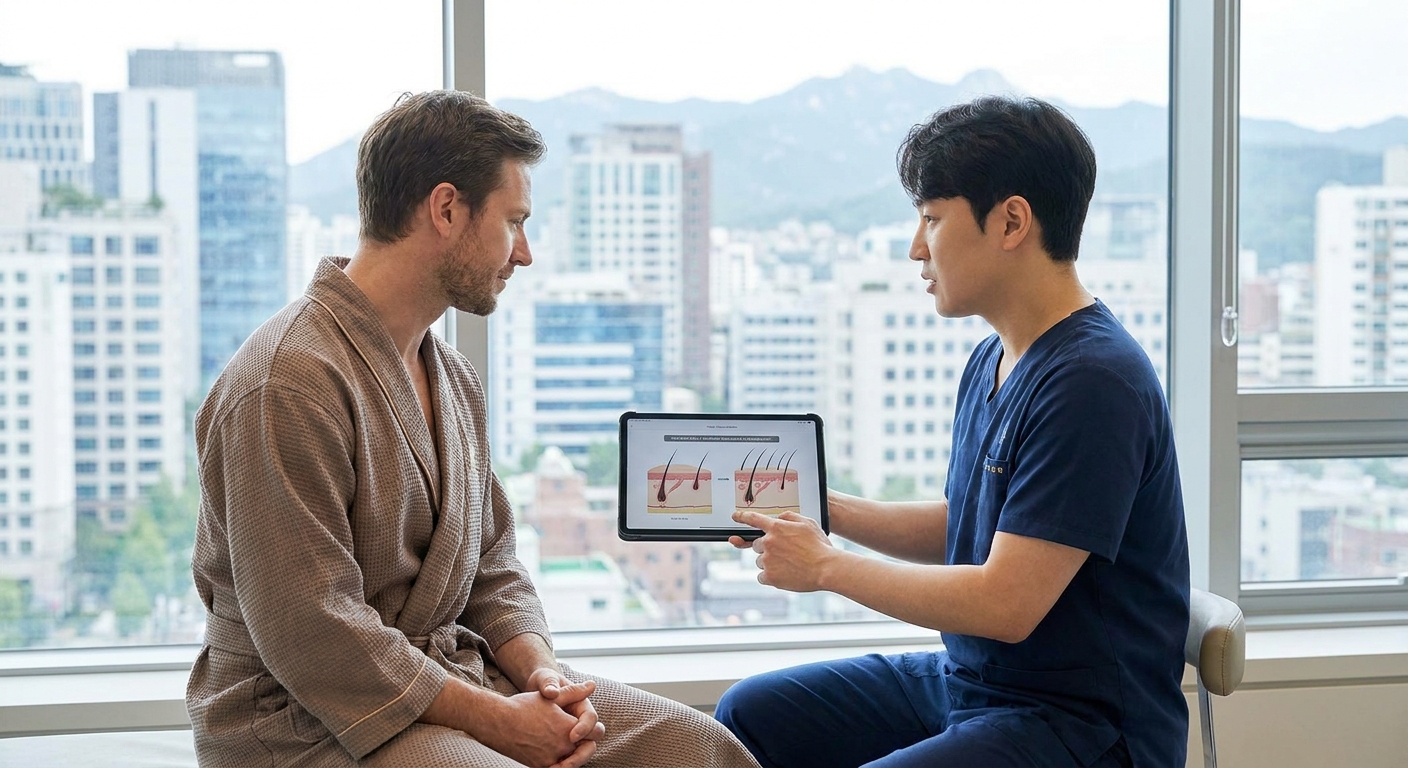
Most Korean clinics run FUE (Follicular Unit Extraction), DHI (Direct Hair Implantation), or a Sapphire-blade variant of FUE. The technique determines scarring pattern, session length, and how dense the final hairline can look — this isn't a cosmetic detail, it's the core of the procedure.
Who Actually Performs Extraction
Ask directly whether the surgeon or a technician handles extraction and implantation. In Korea, board-certified dermatologic or plastic surgeons are required to oversee the procedure, but the ratio of surgeon-hours to technician-hours varies a lot between clinics and changes your result more than any marketing claim does.
Donor Density Assessment
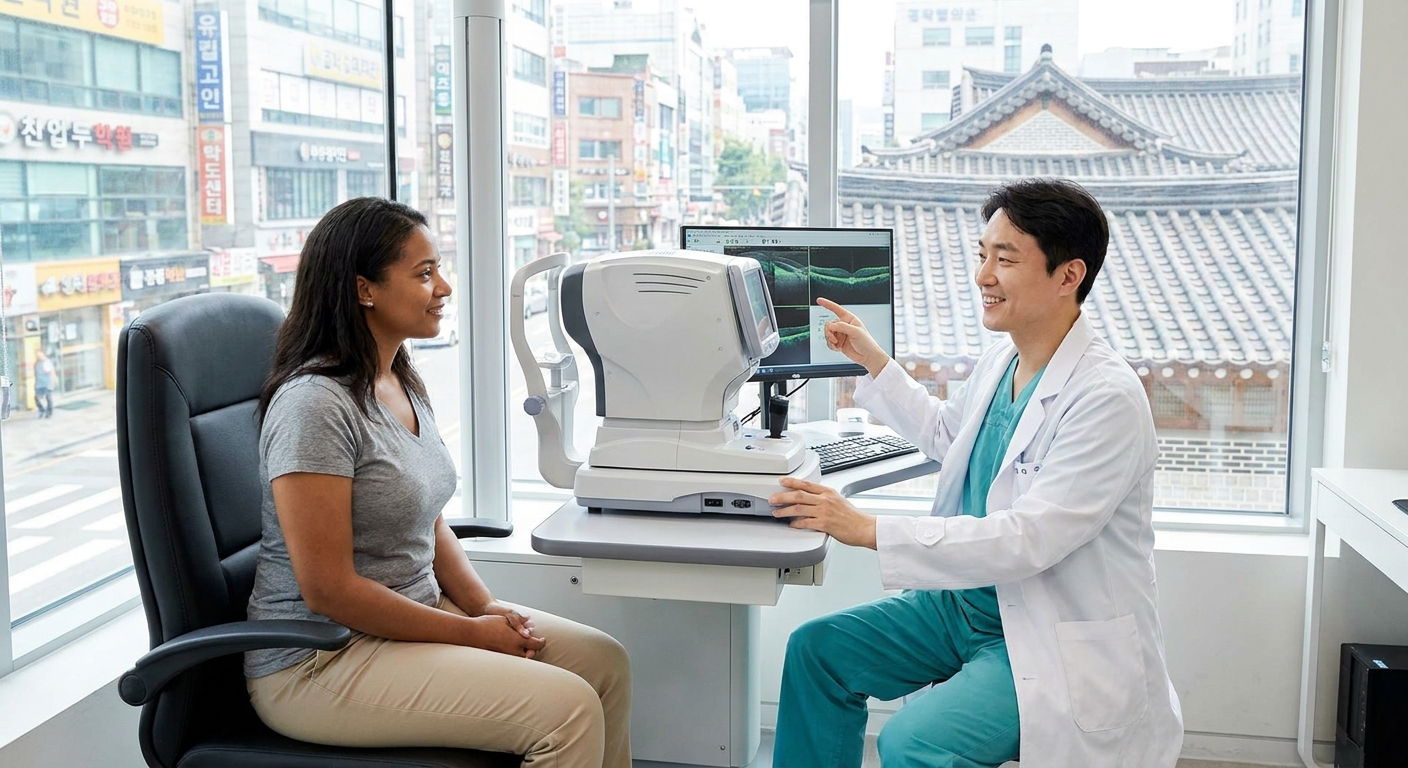
A clinic that hasn't measured your donor density in follicular units per square centimeter hasn't actually evaluated your candidacy — they've given you a generic quote. Real assessment happens before a graft number gets promised, not after.
International Patient Coordination
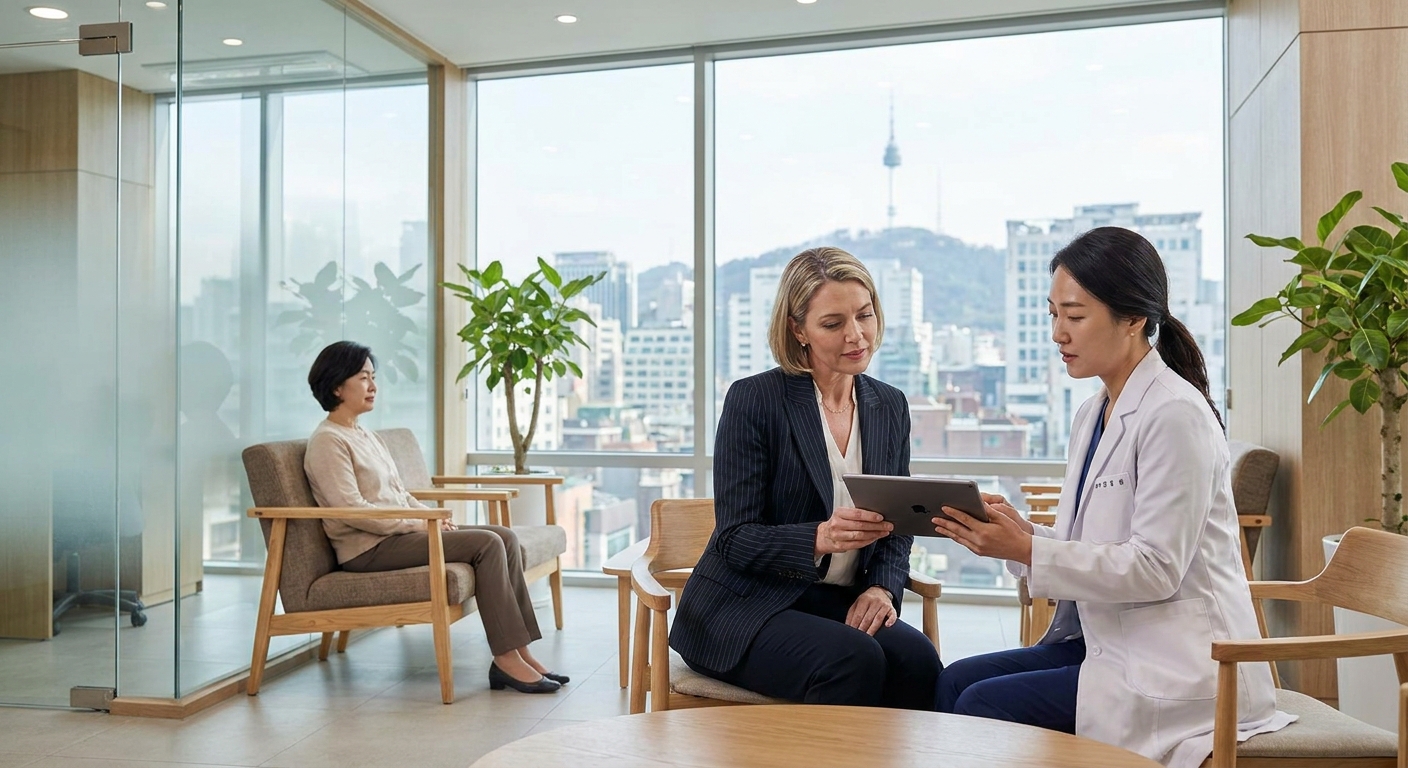
Translation during consultation, English aftercare instructions, and a documented follow-up protocol matter more for foreigners than for domestic patients, since you won't be walking back into the clinic for a same-week check. KHIDI registration is the baseline credential to confirm here.
Recovery Timeline vs. Trip Length
Swelling typically peaks around day 3, scabbing clears by day 10-14, and most patients can fly home after 7-10 days. If your trip is shorter than that window, you're planning around the procedure, not the recovery.
Graft Count Transparency
Quotes should break down cost per graft or per session, not just a flat total. A clinic that won't specify graft count in writing before the procedure is a clinic that can revise the number on the day.
“If a clinic can't tell you your donor density in follicular units per square centimeter, they haven't examined you — they've quoted you.”
Top Picks: Techniques Worth Comparing
FUE — The Reliable Default
FUE remains the standard approach for most male pattern hair loss cases in Korea in 2026, extracting individual follicular units without a linear donor scar. Sessions typically run 6-8 hours for 2,000-3,000 grafts, and recovery follows the standard 10-14 day scabbing window. Verdict: Buy for most candidates with moderate donor density and a hairline that doesn't need micro-precision angling.
DHI — The Density Specialist
Direct Hair Implantation uses an implanter pen to place grafts immediately after extraction, skipping the incision-then-insert step of FUE. This lets surgeons control angle and depth more tightly, which shows up in denser-looking results along the hairline itself. Sessions run longer — often 8+ hours for the same graft count — because implantation is more deliberate. Verdict: Buy if hairline density and angle precision matter more to you than session length.
Sapphire FUE — The Scar-Minimizer
Sapphire blades create narrower incisions than steel punches, which some Korean clinics market as faster healing and less visible scarring in the donor area. The difference is real but incremental — it's a refinement on FUE, not a separate category. Verdict: Consider if you have a lower pain tolerance or plan to wear your hair very short post-recovery.
FUE Combined with PRP — The Booster
Some clinics bundle platelet-rich plasma injections with the transplant to support graft survival and stimulate surrounding native follicles. It adds a session but doesn't change the core transplant technique or graft count. Verdict: Consider as an add-on, not as a reason to choose one clinic over another.
Consultation-Only Hairline Design — The Skip for Non-Candidates
If your donor density is too low to support a natural-looking transplant, a reputable surgeon will tell you that in consultation rather than scheduling a procedure anyway. Any clinic that skips this conversation and books surgery on the first call is optimizing for revenue, not your result. Verdict: Skip the clinic, not necessarily the surgery — get a second opinion first.
Compare vetted Seoul hair transplant clinics
Get matched with KHIDI-registered partner clinics for your consultation.
What to Avoid
- Flat-rate "unlimited graft" packages — legitimate clinics price per graft because donor supply is finite; unlimited pricing usually means lower graft density per session to protect margin.
- Same-day fly-in, fly-out scheduling — a hair transplant needs the 7-10 day recovery window before flying; anything shorter risks scab disruption and graft loss during travel.
- Bundled discounts pairing hair transplants with unrelated cosmetic procedures — a clinic pushing a combined package on your first call is upselling, not assessing candidacy. The same caution applies if you're separately researching Korean nose surgery for foreigners — evaluate each procedure on its own merits before combining trips.
Verdict Comparison
| Technique | Graft Count/Session | Scarring | Session Length | Verdict |
|---|---|---|---|---|
| FUE | 2,000-3,000 | Minimal, dot scarring | 6-8 hours | Buy |
| DHI | 2,000-3,000 | Minimal, tighter angle control | 8+ hours | Buy |
| Sapphire FUE | 2,000-3,000 | Narrower incision | 6-8 hours | Consider |
| FUE + PRP | 2,000-3,000 + booster session | Same as FUE | 8-9 hours | Consider |
| Consult-only, low donor density | N/A | N/A | N/A | Skip |
FAQ
What's the best hair transplant technique in Korea for foreigners in 2026?
FUE and DHI are the two standard options at most Korean clinics in 2026. FUE suits most moderate hair loss cases, while DHI gives more precise density control along the hairline for patients prioritizing that result.
How much does a hair transplant in Korea cost for foreigners?
Pricing is typically quoted per graft, with total cost depending on graft count and technique chosen. Ask any clinic for a written per-graft breakdown before comparing quotes across providers.
Is DHI better than FUE for a receding hairline?
DHI generally gives tighter control over implantation angle and depth, which shows up as denser-looking results along the hairline specifically. FUE remains a strong, more widely available option for broader thinning areas.
How many grafts does a hair transplant in Korea typically need?
Most sessions in Korea run 2,000 to 3,500 grafts depending on the size of the area being treated and donor supply. Your surgeon should confirm this number after a donor density assessment, not before.
How long should I stay in Korea after a hair transplant?
Plan for 7-10 days in Seoul before flying home. Swelling typically peaks around day 3 and scabbing clears by day 10-14, and flying too early risks disturbing healing grafts.
Is a hair transplant in Korea safe for international patients?
It's safe when the clinic is properly licensed and the surgeon performs or directly oversees extraction and implantation. Confirm KHIDI registration and ask specifically who performs each step of the procedure.
Do Korean hair transplant clinics offer English-language support?
Many clinics with an established international patient program provide translation during consultation and English aftercare documentation. This coordination should be confirmed before booking, not assumed from a clinic's website.
When will I see final results from a hair transplant?
Transplanted grafts typically shed within the first 6 weeks before regrowing, and full density is usually visible at 9-12 months. Early shedding is expected and isn't a sign the transplant failed.
One Last Thing
The part that surprises most first-time patients: transplanted grafts shed within the first 6 weeks after surgery before regrowing. That shedding phase looks like failure to anyone who hasn't been told to expect it, and it's the single most common reason patients panic and contact their clinic in a rush during month two. Ask your surgeon to walk you through the shedding timeline in writing before you fly home, not after you notice hair falling out in the shower.