LASIK eye surgery in Korea draws international patients chasing board-certified surgeons, current-generation laser platforms, and treatment-trip logistics built around a short recovery window — this guide breaks down what foreign patients need to check before they book anything in 2026.
- LASIK eye surgery in Korea works best for stable, low-to-moderate myopia — Buy if your prescription hasn't changed in 12 months.
- Most patients fly 24-48 hours post-op; budget a 5-7 day treatment trip minimum, not a weekend.
- Skip any clinic quoting a flat price before a pre-op eye exam — candidacy depends on cornea thickness, not budget.
- Seoul Cosmetic Surgery matches patients with KHIDI-registered clinics; confirm licensing before sending a deposit.
Why this matters
A vision correction procedure is not the same purchase as a nose job or a filler package — you're handing over a cornea, not a soft tissue outcome you can revise later if the first result disappoints you. Get the candidacy screen wrong and you're stuck with dry eye, halos, or a botched flap on a different continent from the surgeon who made the cut.
Seoul Cosmetic Surgery is a KHIDI-registered medical tourism agency, not a clinic — it matches international patients with vetted, board-certified surgeons in Seoul rather than performing procedures itself. That distinction matters for LASIK specifically because vision correction candidacy is a diagnostic call, and a facilitator's job is getting you in front of the surgeon who runs that diagnostic, not selling you a package before your eyes have been examined.
Who this is for
This guide is for adults 20-45 with a stable eyeglass or contact lens prescription who want laser vision correction abroad and are comparing Korea against domestic LASIK pricing in the US, UK, Australia, or Canada. It assumes you haven't had a comprehensive eye exam yet and don't know which procedure — LASIK, LASEK, SMILE, or ICL — actually fits your cornea.
What to look for in LASIK eye surgery in Korea for foreigners
Government licensing and KHIDI registration
Korea's Ministry of Health and Welfare requires medical tourism facilitators to register with KHIDI (Korea Health Industry Development Institute), and the same scrutiny should extend to the surgeons themselves. Ask any coordinator for the surgeon's board certification number before you commit to travel dates — a legitimate agency hands this over without hesitation.
Pre-op diagnostics before you land
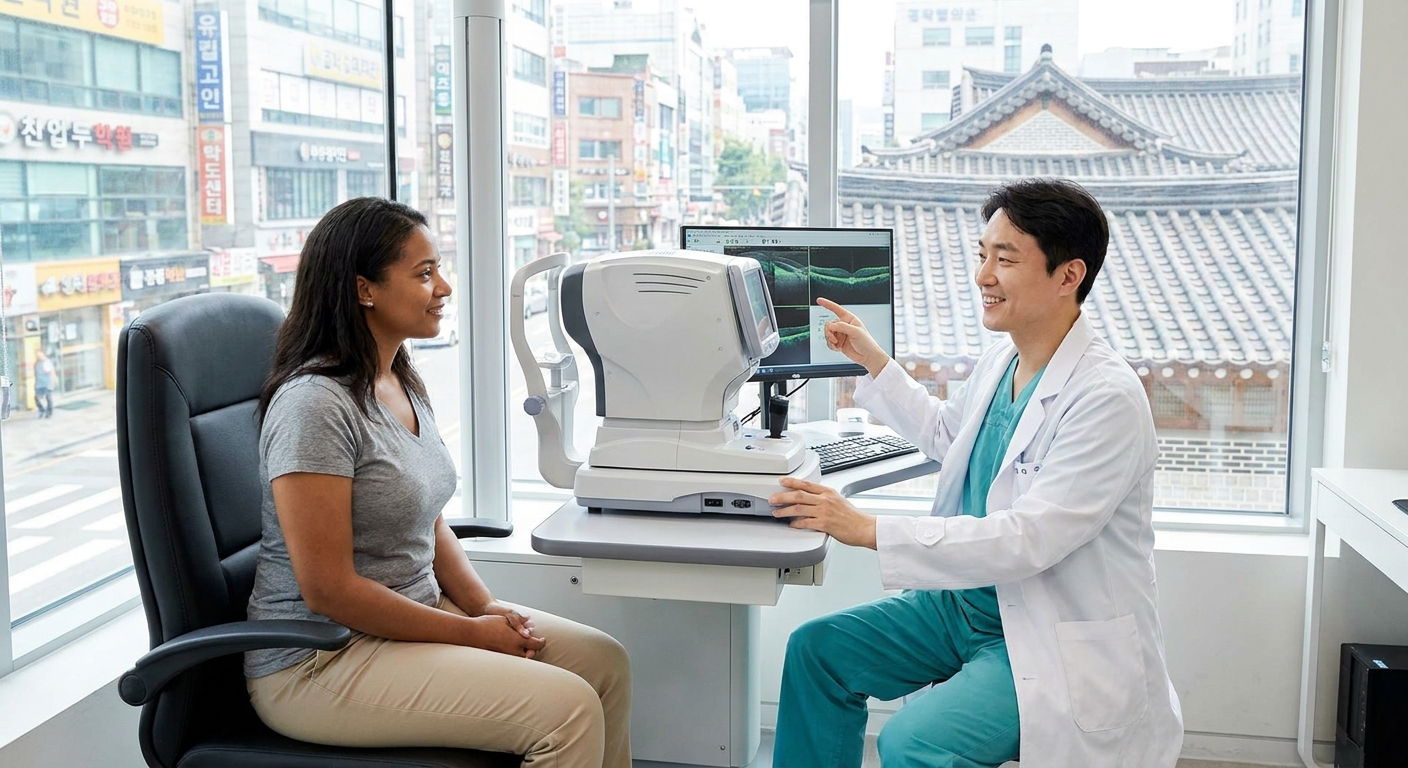
Cornea thickness, refractive stability, and pupil size decide which procedure you're even a candidate for, and none of that is knowable from a phone consultation. A clinic that quotes a fixed LASIK price before running corneal topography is guessing, and that guess is the reason revision cases exist.
English-language coordination throughout the trip
Post-op instructions for eye surgery are time-sensitive — eye drop schedules, no-rubbing windows, and follow-up exam timing all need to be understood exactly, not roughly. A coordinator who speaks your language fluently reduces the chance of a missed step during the 24-48 hour window before you fly.
Procedure matched to your cornea, not your budget
SMILE, LASIK, and ICL solve different problems — thin corneas rule out standard LASIK regardless of how much you're willing to pay for it. Any clinic steering every patient toward the same procedure is optimizing for throughput, not your outcome.
Post-op follow-up plan before you fly home
Dry eye and halos typically peak in the first week, and a same-day exam before departure catches problems while they're still fixable locally. Ask what happens if your one-week check-up flags an issue after you've already landed back home.
Procedure options for international patients
The following is a breakdown of the main vision correction procedures offered to foreign patients in Korea, not a ranking of clinics.
LASIK (standard) — the default pick. Flap-based correction, typically covering -1.00 to -10.00 diopters of myopia with recovery to normal vision within 24-48 hours. Buy if your prescription has been stable for at least a year and your cornea thickness clears the flap threshold.
LASEK/PRK — the thin-cornea workaround. No flap is cut, so it works for corneas too thin for standard LASIK, but visual recovery stretches to 5-7 days with more discomfort in the first 72 hours. Consider it if your pre-op scan shows a cornea under roughly 500 microns.
SMILE (Small Incision Lenticule Extraction) — the smaller-incision option. Covers roughly -1.00 to -8.00 diopters through a 2-4mm incision instead of a full flap, with lower reported dry-eye rates. Buy if you're active or your job involves contact sports where flap displacement risk matters.
ICL (Implantable Collamer Lens) — the high-myopia option. A lens is implanted rather than tissue reshaped, correcting prescriptions up to roughly -18.00 diopters that LASIK can't touch, and it's reversible. Consider it only if your prescription is outside standard laser correction range.
Contoura Vision / topography-guided LASIK — the customization pick. Maps corneal irregularities before cutting, useful for astigmatism that doesn't respond well to standard programming. Consider it if your astigmatism is irregular; Skip it if you're choosing based on price alone since it typically costs more than standard LASIK.
“An agency's job is matching you with the surgeon who runs the diagnostic, not selling you the surgery before it happens.”
What to avoid
- Flat-rate LASIK packages advertised before any eye exam. Real candidacy pricing follows diagnostics, not a marketing page.
- Clinics that won't disclose retreatment or enhancement rates. Every laser vision program has some percentage of patients who need a touch-up; a clinic that dodges the question is hiding the number, not the absence of one.
- English-only marketing with no on-the-ground coordination. A slick website in your language doesn't guarantee a Korean-speaking staff member is available for your actual appointments.
Plan your Korea treatment trip
Get matched with a KHIDI-registered clinic before you book flights.
Verdict comparison
| Procedure | Correction Range | Recovery to Fly | Best For | Verdict |
|---|---|---|---|---|
| LASIK | -1.00 to -10.00 D | 24-48 hrs | Stable moderate myopia | Buy |
| LASEK/PRK | -1.00 to -10.00 D | 5-7 days | Thin corneas | Consider |
| SMILE | -1.00 to -8.00 D | 24-48 hrs | Active lifestyles | Buy |
| ICL | Up to -18.00 D | 24-72 hrs | High myopia | Consider |
| Contoura Vision | Varies | 24-48 hrs | Irregular astigmatism | Consider |
FAQ
What's the best LASIK option for foreigners in Korea?
Standard LASIK is the default choice for stable, moderate myopia with an adequate cornea thickness, typically covering -1.00 to -10.00 diopters. Patients with thinner corneas or higher prescriptions are usually redirected to LASEK, SMILE, or ICL after diagnostics.
Is LASIK eye surgery in Korea safe for international patients?
It's safe when the surgeon is board-certified and the clinic is properly licensed, which is exactly what a KHIDI-registered facilitator screens for before matching you. Safety risk in medical tourism comes almost entirely from skipping verification, not from the country itself.
How much does LASIK cost in Korea compared to the US?
There's no single number — pricing depends on the procedure, correction complexity, and clinic, so ask for a written quote after your pre-op exam rather than trusting an advertised flat rate. A quote given before diagnostics isn't a real quote.
How long do you need to stay in Korea after LASIK?
Plan for a 5-7 day treatment trip minimum even though many patients are medically cleared to fly 24-48 hours after standard LASIK. The extra days cover your pre-op exam, the procedure itself, and a follow-up check before departure.
Can foreigners get LASIK in Korea with high myopia?
Standard LASIK tops out around -10.00 diopters, so patients above that range are typically candidates for ICL instead, which corrects up to roughly -18.00 diopters. Your pre-op corneal scan determines which category you fall into.
Is SMILE better than LASIK for foreign patients?
SMILE isn't universally better — it uses a smaller incision and reports lower dry-eye rates, making it a strong fit for active patients, but its correction range tops out lower than LASIK's. The right choice depends on your prescription and lifestyle, not a blanket ranking.
Do Korean LASIK clinics offer English-speaking staff?
Many clinics serving international patients do, but it varies by clinic and shouldn't be assumed from a website alone. Confirm English-language coordination for both your procedure day and post-op follow-up before you book flights.
What happens if something goes wrong after you fly home?
Ask about the follow-up plan before you travel — a same-day pre-departure exam is designed to catch complications like dry eye or halos while you're still in Seoul. Post-flight issues typically require a local ophthalmologist back home, so get your surgical records before you leave.
One last thing
Most Korean LASIK clinics require patients to stop wearing contact lenses for 1-2 weeks before the pre-op consultation exam, and skipping that window is the single most common reason for a same-day reschedule. Contacts temporarily reshape the cornea, and even one night of lens wear before the diagnostic scan can throw off the topography readings the surgeon needs to pick your procedure.