Choosing among the best hair transplant clinics in Seoul means matching your hair loss pattern, donor supply, and budget to a clinic's actual specialty — not just picking whichever ad shows up first.
- High-volume FUE clinics in Seoul suit early Norwood 2-3 loss with strong donor supply — book with confidence in 2026.
- Surgeon-led boutique clinics cost more but matter most for scarred or limited donor areas.
- Revision and scar-camouflage specialists are the right call for a failed transplant done elsewhere.
- Female pattern hair loss needs a clinic running a female-specific density protocol, not a male template.
- Seoul Cosmetic Surgery is an agency matching patients to vetted partner clinics — it does not perform surgery.
Why this matters
Hair loss brings a lot of international patients to Seoul, alongside rhinoplasty and other cosmetic procedures — the city has one of the densest concentrations of dedicated hair restoration surgeons in Asia. Patients from the US, UK, Australia, and Canada travel here specifically because Korean clinics run high case volumes and refine technique fast because of it.
The risk isn't a bad clinic outright — it's a mismatched one. A clinic that's excellent at high-volume male-pattern FUE isn't necessarily the right pick for a female hairline lowering case or a revision job on scarred donor tissue. Seoul Cosmetic Surgery is a KHIDI-registered medical tourism agency, not a clinic — it matches international patients with board-certified surgeons across more than 30 partner clinics in Seoul, and clinics pay the agency, not the patient.
How clinic profiles get ranked
The list below groups clinics by what they're actually built to do well, based on technique offered, whether a surgeon or a technician performs extraction and implantation, and whether the clinic runs revision or female-specific protocols. KHIDI registration and board certification are the floor, not the differentiator — every legitimate clinic should clear that bar in 2026. What separates them is specialization.
1. High-volume FUE-only clinics — the workhorse pick
These clinics run assembly-line efficiency on Follicular Unit Extraction, built for early-to-mid Norwood 2-3 male pattern loss with a healthy donor area. Sessions typically run 6 to 10 hours and handle 2,000 to 3,500 grafts depending on the balding area.
The tradeoff is throughput over customization — good if your case is straightforward, less ideal if you have scarring or a thin donor zone.
Verdict: Book — if your donor supply is strong and your case is early-stage, this profile is the most cost-efficient path.
2. Surgeon-led boutique clinics — the premium pick
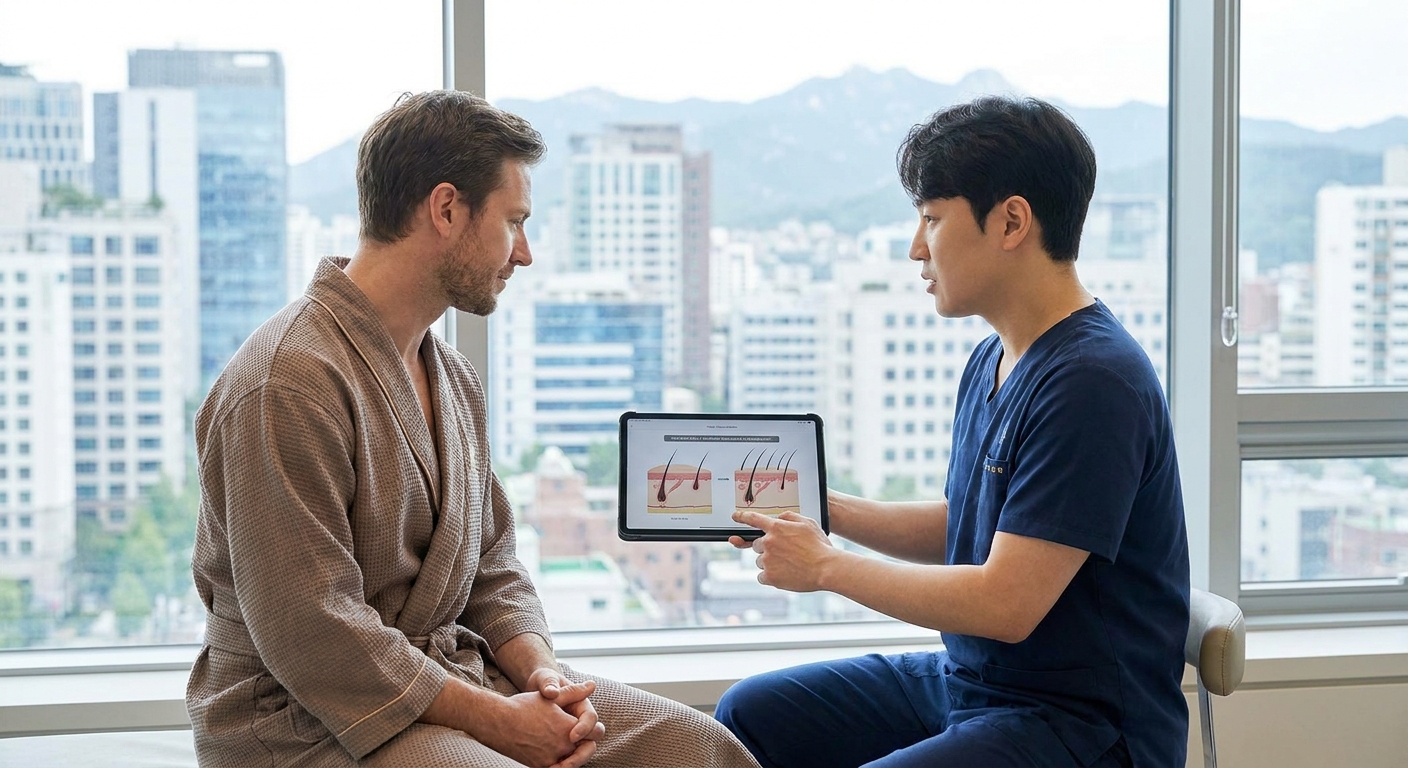
Here the surgeon personally handles extraction and implantation instead of delegating to a technician team. That distinction matters most when donor supply is limited or previous scarring makes graft placement technically harder.
Expect a longer intake process and a higher price point than volume clinics, but more control over graft angling and density in visible zones like the hairline.
Verdict: Book — worth the premium if your case isn't a straightforward one.
3. Combination FUE+FUT/strip specialists — the maximalist pick
For advanced Norwood 5-6 loss, FUE alone often can't harvest enough grafts. Clinics that combine FUE with strip (FUT) harvesting can pull significantly more grafts in a single session, at the cost of a linear donor scar.
If you plan to keep hair long enough to hide a donor scar, this tradeoff is manageable. If you wear your hair short, it's a dealbreaker.
Verdict: Consider — only if graft yield matters more to you than donor-scar visibility.
4. Female hairline and density clinics — the underrated pick
Female pattern hair loss isn't just a smaller version of male pattern loss — density loss is usually diffuse rather than a receding hairline, and graft angling differs. Not every Seoul clinic runs a female-specific protocol; some default to the same template used for male patients.
Ask directly whether the clinic has treated diffuse female thinning before booking.
Verdict: Book if the clinic can show a female-specific approach — Skip if they can't articulate the difference.
5. Revision and scar-camouflage specialists — the fix-it pick
Patients arriving with a failed transplant from another country — visible plugs, an over-wide donor scar, an unnatural hairline — need a surgeon skilled in scar excision and camouflage grafting, a different skill set from a first-time FUE case. Seoul has clinics that specialize almost exclusively in revision work, the same way some Seoul clinics focus specifically on revision rhinoplasty rather than primary nose jobs.
Verdict: Book — a generalist FUE clinic is the wrong pick for a revision case, regardless of price.
6. Beard-to-scalp and body-hair transplant clinics — the niche pick
When scalp donor supply runs out entirely, some Seoul clinics harvest from the beard or chest as an alternative donor source. Fewer clinics run this reliably — the hair texture and growth cycle differ from scalp hair, so technique matters more here than volume.
Verdict: Consider — confirm through the agency that the clinic has a track record with this specific technique before booking.
“If a clinic won't confirm whether the surgeon does the extraction personally, that's your answer.”
Comparison at a glance
| Clinic profile | Best for | Scar risk | Verdict |
|---|---|---|---|
| High-volume FUE | Early male pattern loss | Minimal, dot scarring | Book |
| Surgeon-led boutique | Limited donor supply | Minimal | Book |
| FUE+FUT combination | Advanced Norwood 5-6 | Linear donor scar | Consider |
| Female density/hairline | Diffuse female thinning | Minimal | Book (if protocol confirmed) |
| Revision/scar specialists | Failed prior transplant | Camouflaged | Book |
| Beard-to-scalp | Depleted scalp donor | Minimal | Consider |
Many international patients combine a hair transplant trip with another procedure while in Seoul — it's common to see the same clinic network handling requests for gynecomastia surgery alongside hair restoration during a single travel window, since recovery timelines don't overlap.
Where to book
- Confirm KHIDI registration and surgeon board certification before you commit — this is the non-negotiable floor for any clinic on this list in 2026.
- Ask who physically performs extraction and implantation — a surgeon-performed case and a technician-performed case are not the same product, even at the same clinic.
- Get an itemized quote in writing before you travel — graft count, technique, and revision terms should be specified, not estimated on arrival.
Match with a vetted Seoul clinic
Get matched to a partner clinic based on your hair loss pattern and donor supply.
FAQ
What are the best hair transplant clinics in Seoul for FUE?
High-volume FUE clinics that specialize in early-to-mid Norwood pattern loss are the best fit for standard FUE cases in Seoul in 2026. Surgeon-led boutique clinics are the better pick if your donor supply is limited or you have prior scarring.
Is Korea good for hair transplants?
Seoul has one of the highest concentrations of dedicated hair restoration surgeons in Asia and draws patients from the US, UK, Australia, and Canada specifically for this reason. Case volume and technique specialization vary widely by clinic, so matching your case type to the right specialty matters more than the country alone.
How much does a hair transplant cost in Seoul in 2026?
Cost depends on graft count, technique, and whether a surgeon or technician performs the procedure, so figures vary clinic to clinic. Ask a partner clinic for an itemized quote before booking rather than relying on a general estimate.
Do Seoul clinics use surgeons or technicians for extraction?
It depends on the clinic profile — high-volume FUE clinics often use trained technician teams under surgeon supervision, while boutique clinics have the surgeon perform extraction and implantation personally. Ask directly before booking since this affects both price and precision.
Can I combine a hair transplant with another procedure in Seoul?
Yes, many international patients schedule a hair transplant alongside a separate cosmetic procedure during the same trip since recovery windows often don't overlap. Confirm timing with your matched clinic since donor-area healing still needs to be respected.
Is Seoul Cosmetic Surgery a clinic or an agency?
Seoul Cosmetic Surgery is a KHIDI-registered medical tourism agency, not a clinic, and does not perform surgery itself. It matches international patients with board-certified surgeons across more than 30 partner clinics in Seoul.
What should I check before booking a hair transplant clinic in Seoul?
Confirm KHIDI registration, surgeon board certification, and whether the surgeon personally performs extraction and implantation. Get an itemized quote in writing before you travel rather than an on-arrival estimate.
How long until hair transplant results show in Seoul patients?
Final density typically shows at 12 to 18 months post-procedure, following an initial shed period around weeks 3 to 4. Early growth is visible sooner, but judging results before the 12-month mark is premature.
One last thing
The single biggest predictor of a good outcome isn't the clinic's marketing photos — it's whether they'll tell you plainly if your case isn't a fit for their specialty. A revision specialist turning down a straightforward early-stage FUE case, or a volume clinic referring out a female diffuse-thinning patient, is a better sign than a clinic that says yes to everything.